Troubleshooting · November 12, 2026 · 8 min read
Refrigerator not cooling in Pittsburgh? Move quickly to protect the food. Check the temperature setting, door seal, interior vents and power. If the fridge still warms up, book a diagnostic visit and leave electrical or compressor work to a technician.
First, protect your food
Use an appliance thermometer if you have one. The refrigerator should be at or below 40°F, and the freezer at 0°F. Keep the doors shut as you work through the problem. During a power outage, an unopened refrigerator keeps food cold for about four hours. Discard refrigerated perishables after four hours without power, or when you know they have been above 40°F for two hours or more. Smell and taste cannot establish whether food is safe.
“An unopened refrigerator keeps food cold for about four hours during a power outage if the door remains closed.” – USDA Food Safety and Inspection Service
If the power is on but cooling has failed, the four-hour outage rule cannot tell you how long the food has been warm. Measure the food or compartment temperature, move perishables to a working refrigerator or cooler with ice if you can, and discard food that meets the time-and-temperature threshold above. If you cannot tell how long perishable food has been warm, throw it out.
Refrigerator not cooling? Four checks before booking repair
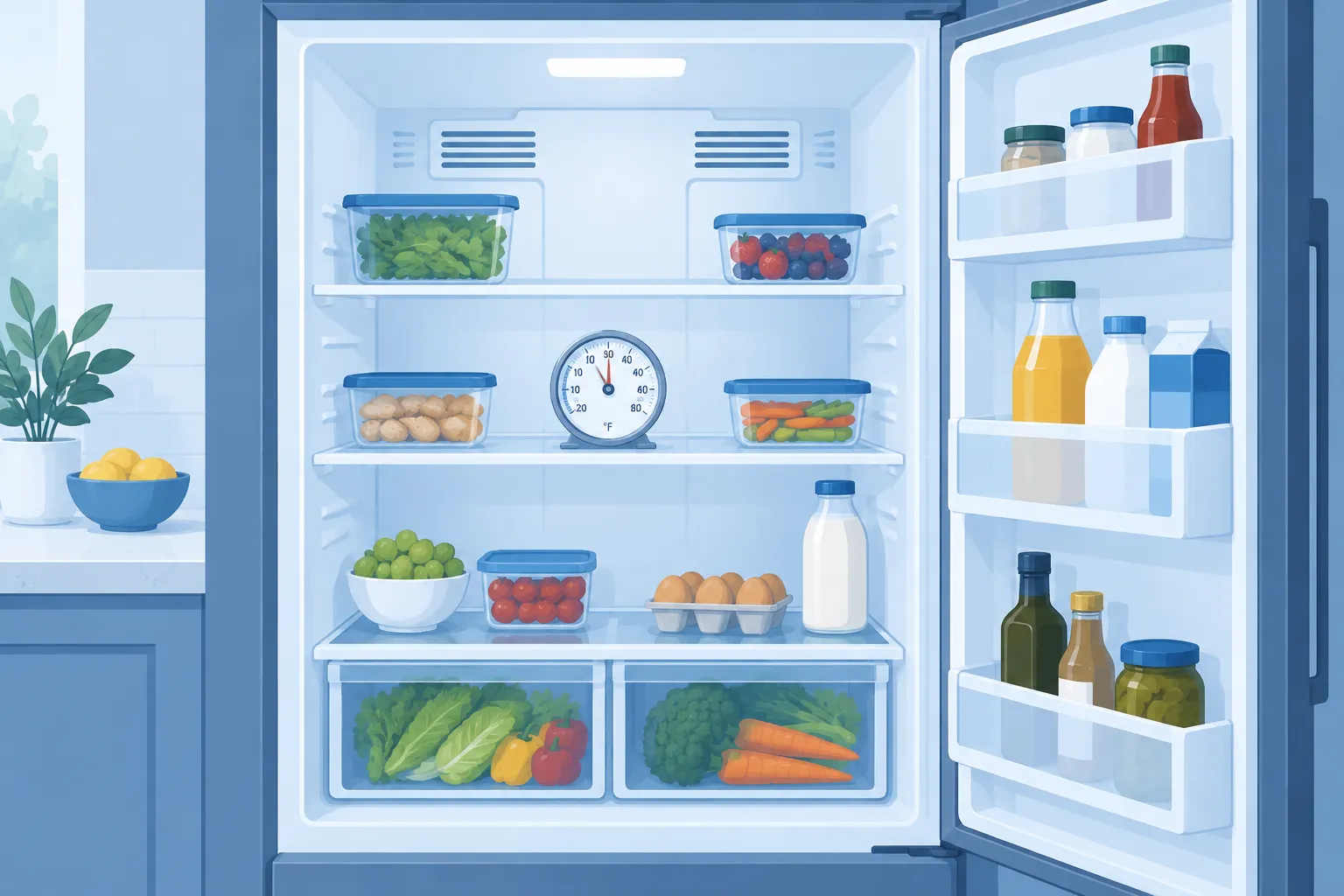
You can make these checks without removing a panel or touching wiring. If you notice a burning smell, sparking or a damaged cord, stop using the appliance and get qualified help.
Setting and display: The fresh-food section may have been set warmer by accident or switched into an off or demo mode. Set it for safe food storage, then use a thermometer to measure the temperature; the control number alone cannot tell you how cold the food is.
Door seal: Remove anything caught between the door and cabinet, wipe a dirty gasket, and close the door. A torn, loose or misshapen seal needs attention. Pushing harder on the door will not fix it.
Interior vents: Move boxes and containers away from air outlets in both compartments. Crowded shelves can restrict airflow even when the freezer feels cold.
Recent power trouble: Check the outlet and breaker. After an outage, use the thermometer to see whether cooling has returned; working lights alone do not settle it. If the breaker trips again, stop resetting it.
If you can see dust on accessible condenser coils, consult the appliance manual before cleaning them. Unplug the refrigerator first. Leave heavy units and mechanical compartments alone.
Match the symptom to the likely trouble spot
| What you notice | What it may mean | Your next move |
|---|---|---|
| Freezer is cold, refrigerator is warm | Airflow between compartments may be blocked; a fan, damper or defrost fault may also be involved. | Clear interior vents. If temperatures stay high, book a diagnosis. |
| Both compartments are warm, but lights work | The appliance has power, but the cooling system may not be starting or removing heat. | Confirm settings and power, then arrange service if cooling does not return. |
| Frost builds up and the fridge warms | Ice can obstruct the path of cold air; the cause may be a door-seal or defrost problem. | Check door closure and book repair if frost returns or cooling remains poor. |
| Clicking, unusual buzzing or no familiar fan sound | A starting component, fan or another part may need diagnosis. | Leave covers in place and tell the technician what you heard. |
Use these symptoms to describe the problem to a technician, not to choose a replacement part. A compressor that appears to run does not prove refrigerant is circulating correctly. More than one fault can leave a refrigerator warm, and a sound alone will not identify the right repair.
When to stop troubleshooting and book repair
Book a professional visit if the refrigerator cannot hold a safe temperature after the basic checks. The same goes for a cold freezer with a warm fresh-food section or frost that returns with poor cooling. A failed fan motor, compressor problem, electrical fault or sealed-system issue calls for a technician.
Pittsburgh-area homeowners can request residential refrigerator repair from Pittsburgh Refrigerator Repair. Tell the team which compartments are warm, when you noticed the change, what the thermometer reads, and whether an outage or unusual noise came first. Those details help focus the diagnostic visit. The business also offers emergency service for urgent cooling failures; availability depends on scheduling.
What happens at a diagnostic visit?
Pittsburgh Refrigerator Repair inspects the refrigerator and provides an upfront quote before repair work begins. Its website has a repair cost estimator for an initial sense of potential costs. Use the diagnostic quote to compare repairing the appliance with replacing it, and ask for the parts-and-labor warranty terms that apply to the proposed work.
The business serves Pittsburgh and surrounding communities and works on major refrigerator brands, including premium models. A technician may identify a need for fan motor repair or compressor repair; the symptom alone cannot settle which. If the freezer has its own problem, see freezer repair in Pittsburgh. The service area page lists the communities covered.
Have the model number and a short account of the symptoms ready when you book. If the quote calls for a major repair, weigh it against the cost and condition of a replacement. Take care of the food while you wait for service.
Protect perishables and make the four external checks. If the fridge stays warm, book a diagnosis with Pittsburgh Refrigerator Repair. Its upfront quote and parts-and-labor warranty give you a concrete basis for deciding whether to repair the appliance.
FAQ
My refrigerator isn't cooling. What can I do to troubleshoot this?
Check the temperature setting, door seal, blocked vents and power supply without removing panels. Use a thermometer to see whether the refrigerator stays at or below 40°F. If it remains warm, protect perishables and arrange a diagnostic visit.
My Frigidaire refrigerator isn't cooling and the condenser fan is running. What could be causing this?
A running condenser fan shows that one component is working, not that the whole cooling system is healthy. Blocked airflow, a different fan, a defrost issue or a cooling-system fault could still be involved. Check the setting, seal and interior vents, then book a diagnosis if temperatures stay unsafe.